
In 2026, the definition of “status” in Metro Manila has shifted. It is no longer about the brand of car you drive, but how much time you don’t spend inside one. As fuel prices fluctuate and the “Big 3” business districts—Makati, BGC, and Ortigas—become increasingly congested, a new movement is taking root: the Car-Lite Lifestyle.
The concept is simple: prioritizing walking, cycling, and mass transit over private car ownership. But in a city notorious for its humidity and unpredictable rains, is it actually survival-proof? If you’re positioned in a transit-oriented hub like Cubao, the answer is a resounding yes.
Here is how you can successfully navigate Metro Manila without the burden of a personal vehicle, featuring the strategic connectivity of Vivaldi Residences Cubao.
1. The Financial Freedom of Going Carless
Owning a car in 2026 is an expensive endeavor that goes far beyond the monthly amortization. When you factor in the cost of a condo parking slot (which can cost nearly as much as a small studio), insurance, maintenance, and the ever-rising “gas pain,” the numbers are staggering.
By opting for a car-lite lifestyle, you significantly lower your monthly expenses. This allows you to reallocate those funds toward Real Estate Investment in the Philippines or accelerating your Steps and Timeline for a Pag-IBIG Housing Loan.
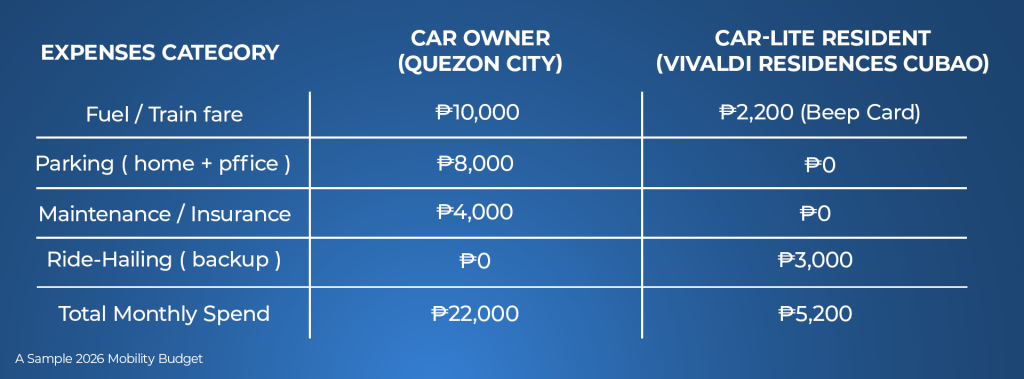
The Math of Mobility: In 2026, the average car owner in QC spends roughly ₱15,000 to ₱20,000 monthly on fuel and parking alone (BusinessWorld, 2026). Transitioning to a transit-heavy lifestyle can cut that expense by nearly 70%.
2. Cubao: The 15-Minute City Archetype
For a car-lite lifestyle to work, your home must be situated in a “15-minute city”—an urban planning concept where all your daily essentials are within a 15-minute walk or train ride. Living in Vivaldi Residences Cubao fits perfectly for this lifestyle.
- Dual-Line Connectivity: Residents are steps away from the MRT-3 (North-to-South) and the LRT-2 (East-to-West). This intersection allows you to bypass the EDSA “parking lot” entirely (Colliers Philippines, 2026).
- The Hub of Everything: From the Farmers Market for fresh groceries to the Gateway Mall for retail and the Smart Araneta Coliseum for world-class entertainment, everything is reachable via covered walkways.
- Active Mobility: With the city government expanding protected bike lanes along major QC corridors, cycling from Cubao to nearby New Manila or Diliman is more viable than ever in 2026.
3. Beating the Fuel Price Shock
We’ve previously discussed How to Beat the 2026 Fuel Price Shock, and the most effective strategy remains the same: reducing your dependence on the pump. When you live in a transit-oriented development (TOD), your “commute” becomes a predictable, flat-rate expense. You are no longer at the mercy of global oil prices or the “surge” pricing of ride-hailing apps during rush hour.
4. What About the “Hard” Days?
Living car-lite doesn’t mean you never use a car; it means you use one intentionally.
- Ride-Hailing for Emergencies: Use popular utility apps for grocery hauls or rainy nights.
- Car Rentals: For weekend out-of-town trips to Tagaytay or La Union, renting a vehicle is often cheaper than the annual depreciation and upkeep of owning one.
- Inter-City Travel: With Vivaldi Residences Cubao being the gateway to provincial bus terminals, even trips to Northern or Southern Luzon are more accessible without a car.
A Sample 2026 Mobility Budget
Reclaim Your Time at Vivaldi Residences Cubao
The greatest luxury of the car-lite lifestyle isn’t the money—it’s the time. Instead of spending 10 hours a week staring at the brake lights of the car in front of you, you can spend that time at the gym, with your family, or resting in your unit.
At Euro Towers, we build for the future of Metro Manila. Our Vivaldi Residences Cubao project is designed specifically for the modern Filipino who values efficiency, sustainability, and urban agility.
Are you ready to trade your car keys for a more liberated lifestyle? Our Ready for Occupancy (RFO) units in Cubao are open for viewing. Schedule a Site Visit today.
References
BusinessWorld. (2026, January 18). The true cost of car ownership in Metro Manila: 2026 update. https://www.bworldonline.com/velocity/2026/03/09/734734/add-it-up/
Colliers Philippines. (2026, February 12). Philippine property market report: The premium of transit-oriented living. https://www.colliers.com/en-ph/research/
Department of Transportation (DOTr). (2025, November 10). Active transport expansion: Progress on QC bike lane networks. https://dotr.gov.ph/news/
Meralco. (2026). Powering the future of transport: EV charging and transit hubs. https://www.meralco.com.ph/residential/electric-service/start-or-modify/start-service