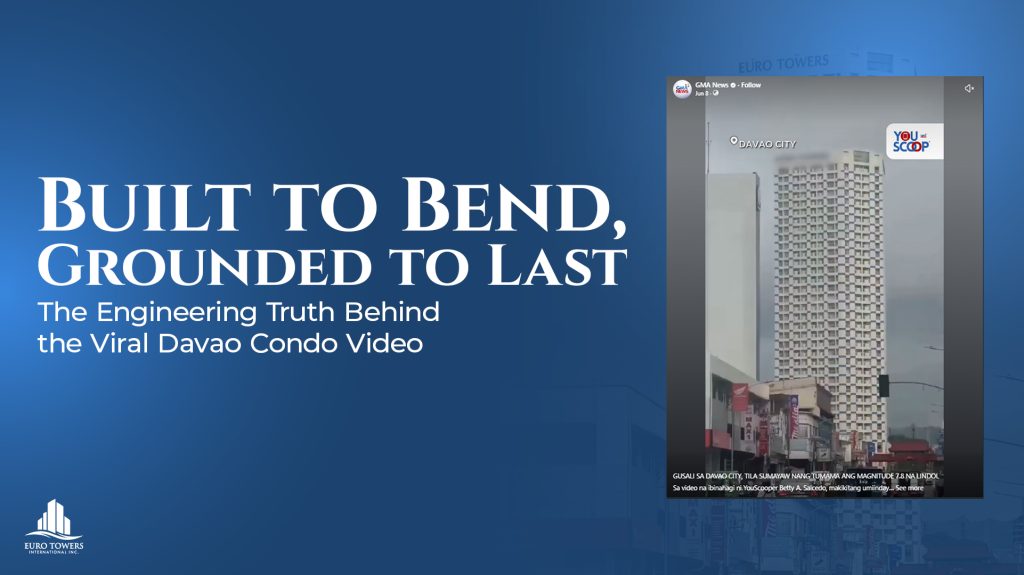
Following the powerful magnitude 7.8 Mindanao earthquake on June 8, 2026, raw footage capturing the visible swaying of the 36-storey Vivaldi Residences Davao generated intense discussion across social media. To the untrained eye, seeing a skyscraper shift against the skyline looks terrifying. However, to structural engineers, that rolling movement was a live demonstration of a building working exactly as it was designed to do to.
While the public conversation focused entirely on how the tower moved above the ground, the real reason the building stood strong lies completely out of sight. To manage public safety narratives after a crisis, we must look past the social media feeds and dig into the actual engineering data and structural foundation of the building.
1. The Hazard of Absolute Rigidity
A common misconception about high-rise safety is the idea of a “rock-solid” building. Many believe that a skyscraper should remain completely stiff to be considered strong. In structural engineering, however, absolute rigidity is a severe hazard.\Structures designed without sufficient flexibility perform poorly under strong seismic loading because earthquake forces need to be safely dissipated.
If a tall tower is built to be 100% stiff with no structural allowance for movement, it will absorb the entire kinetic force of seismic waves directly into its foundation, columns, and beams. Without a path to safely dissipate or release that immense energy, a rigid concrete structure is highly susceptible to brittle failure, causing columns to snap under sudden tension and potentially collapse (Chopra, 2020).
Modern vertical developments are master-planned to bend under stress without breaking,a property known as Seismic Ductility (Gioncu & Mazzolani, 2013). By allowing the upper floors to flex and roll smoothly, the building behaves like a giant shock absorber, safely distributing kinetic energy away from the primary structure (Taranath, 2016).
2. 60 Meters Deep: The Power of a Deep Foundation
Long before Vivaldi Residences became a prominent part of Davao’s skyline, it was built from the ground up with raw structural strength in mind. While ductile design handles the kinetic energy in the air, a massive underground anchor is required to secure the building’s base during a major earthquake (Moehle, 2014).
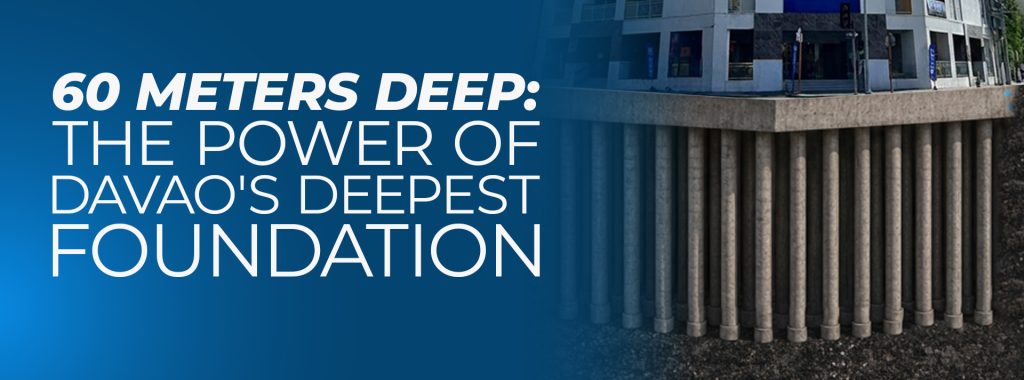
Beneath the visible structure of Vivaldi Residences Davao lies its greatest engineering asset—70 bored piles extending up to 60 meters below ground.
Designed specifically to carry immense vertical loads and resist lateral tectonic shifting, this heavily reinforced concrete foundation system remains the deepest known building foundation in Davao City. Combined, these massive underground foundation elements reach a depth comparable to an entire 20-storey building buried beneath the earth. This massive subterranean network creates an incredibly solid base engineered for maximum long-term stability, ensuring that no matter how much the earth shifts, the building remains anchored to its core.
3. Post-Earthquake Safety Statuses
After an earthquake, the Office of the City Building Official (OCBO) and structural engineers conduct visual assessments to maintain public safety and control perimeter hazards.
Following the June 2026 quake, initial cautionary notices or “Red Tags” issued by local authorities on high-rises often point to localized risks, such as falling facade panels or cosmetic debris hazards along the public road perimeter, rather than a failure of the main skeleton. (MindaNews)
This distinction is vital for accurate crisis management. In the case of Vivaldi Residences Davao, the initial restrictive notice was implemented by local officials specifically due to a falling-debris risk along the exterior perimeter facing the public road after an architectural facade element detached. A comprehensive structural evaluation by specialized structural consultants, AC Pama Engineering Consultancy, officially verified that the building’s core load-bearing columns and underlying structural skeleton remain entirely sound, secure, and intact.
Watch our explainer on how Vivaldi Residences Davao was engineered from the ground up.
The Resident’s Guide: Personal Emergency Preparation
While a modern skyscraper is engineered to structurally preserve its own core, high-rise residents must know how to properly protect themselves inside their units. Because structural swaying is amplified on upper floor levels to protect the base, interior shaking will feel very intense.
During the Tremor (Action)
- Drop, Cover, and Hold On: Do not attempt to run out of the building or use the stairwells while the ground is actively moving. Drop to your hands and knees, take immediate cover under a sturdy desk or heavy table, and hold on tight until the shaking stops (PHIVOLCS, 2022).
- Stay Clear of Balconies: Avoid stepping out onto balconies during a tremor. The shifting motion is felt most severely outdoors, and falling exterior debris presents an immediate risk.
- Stay Away from Elevators: High-rise elevator systems feature automated seismic sensors designed to instantly trip and shut the cabs down safely to prevent passenger entrapment.
After the Motion Subsides (Evacuation)
- Anticipate Aftershocks: Allow the structure a few moments to settle, as immediate aftershocks can easily trigger subsequent swaying.
- Follow Property Management Directives: Modern vertical communities utilize centralized Public Address (PA) speakers. Wait calmly for official announcements from your building administration. If an evacuation is formally declared, exit orderly using the designated emergency fire stairs—never attempt to use the elevators.
Enduring Strength
From foundation to framework, every stage of construction for this vertical landmark was executed with a strict commitment to quality, durability, and resilience. Seeing a high-rise move during a tectonic event can be unsettling, but understanding the science behind the sway brings peace of mind.
The recent tremors in Mindanao did not expose structural weakness; instead, they proved that thoughtful engineering operates flawlessly under pressure.
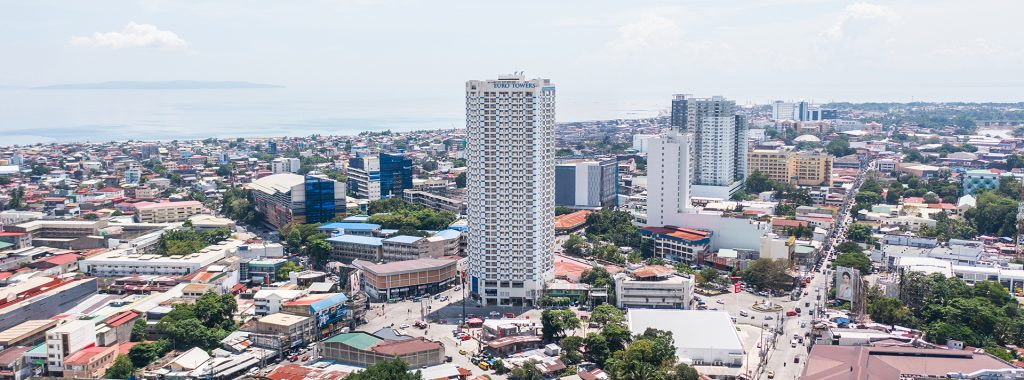
Vivaldi Residences Davao stands not just as a testament to modern architectural design, but as a safe haven built on strength, and truly designed to last.
References
- Association of Structural Engineers of the Philippines (ASEP). (2015). National Structural Code of the Philippines (NSCP) Volume 1: Buildings, Towers, and Other Vertical Structures (7th ed.). ASEP.
- Chopra, A. K. (2020). Dynamics of Structures: Theory and Applications to Earthquake Engineering (5th ed.). Pearson.
- Federal Emergency Management Agency (FEMA). (2023). Earthquake Safety at Home: Preparing for the Next Big One. U.S. Department of Homeland Security.
- Gioncu, V., & Mazzolani, F. M. (2013). Earthquake Engineering for Structural Design. CRC Press.
- MindaNews. (2026, June 11). Map of buildings issued Red and Yellow tags by Davao City’s OCBO after the Magnitude 7.8 earthquake. MindaNews. https://mindanews.com/top-stories/2026/06/map-of-buildings-issued-red-and-yellow-tags-by-davao-citys-ocbo-after-the-magnitude-7-8-earthquake/
- Moehle, J. (2014). Seismic Design of Reinforced Concrete Buildings. McGraw-Hill Education.
- Philippine Institute of Volcanology and Seismology (PHIVOLCS). (2022). Earthquake Preparedness Guide: What to Do Before, During, and After an Earthquake. Department of Science and Technology.
- Taranath, B. S. (2016). Structural Analysis and Design of Tall Buildings: Steel and Composite Construction. CRC Press.