
Moving into a new condo is an exciting milestone, especially as professionals and young families navigate the bustling 2026 Metro Manila real estate market. However, the excitement of finding the perfect unit can quickly turn into financial stress if you are not prepared for the upfront costs.
When you inquire about a condo for rent, the advertised monthly rate is only part of the equation. Before you are handed the keys, landlords and property managers will require a lump sum of deposits, advance payments, and association dues.
To help you budget effectively and protect your hard-earned money, here is your definitive 2026 guide to understanding condo rental fees in the Philippines.
1. The Golden Rule: “1 Month Advance, 2 Months Deposit”
If you have browsed any property listings recently, you have likely seen the phrase: Terms: 1 month advance, 2 months deposit. This is the absolute standard in the Philippine rental market, and it is heavily regulated by law.
Under the Rent Control Act of 2009 (Republic Act 9653), landlords are legally permitted to collect a maximum of one month’s advance rent and two months’ security deposit for properties covered by the act. If an agent or landlord demands five or six months of security deposits upfront, consider it a massive red flag.
Here is exactly where that money goes:
- The Advance Rent: This is essentially you paying for your first month of living in the unit before you even move in. For example, if you move in on April 1st, your one-month advance covers your rent for the entire month of April. Your next actual rent payment will not be due until May. (Respicio & Co., 2026)
- The Security Deposit: This amount (equivalent to two months of rent) is held by the landlord for the duration of your lease. It acts as a safety net. If you damage the property, break a window, or leave unpaid Meralco and water bills when you move out, the landlord will deduct those costs from this deposit. If you finish your lease with the unit in perfect condition and all bills paid, the security deposit is fully refundable, typically within 30 days after you vacate the premises. (Respicio & Co., 2026)
2. Association Dues: The Monthly Upkeep
Aside from your actual rent, the most significant ongoing cost of living in a condominium is Association Dues (often called HOA dues or condo dues).
These fees are collected by the Condominium Corporation to fund the upkeep of the building’s shared spaces. This includes paying the 24/7 security guards, cleaning the hallways, maintaining the elevators, keeping the swimming pool clean, and covering the building’s fire insurance.
How Association Dues are Calculated:
Dues are not a flat rate; they are calculated based on the size of your unit (per square meter). In 2026, standard association dues in Metro Manila range from ₱70 to ₱150 per square meter, depending on the location and the luxury level of the amenities. (C2M3 Properties, 2026)
Budgeting Example: If you rent a 30-square-meter unit and the building’s dues are ₱100/sqm, your monthly association dues will be ₱3,000.
Pro Tip: Always clarify with your landlord if the advertised rental price is “inclusive” or “exclusive” of association dues. If a unit is advertised at ₱18,000/month inclusive of dues, you only pay ₱18,000. If it is exclusive, you will have to pay the ₱18,000 rent plus the ₱3,000 dues out of pocket every month. (Mainline Power, 2026)
3. Utility Deposits and Admin Fees
Beyond rent and dues, building administrations often require a few minor, one-time fees before you can officially move in.
- Utility Connection Deposits: Some landlords require a small deposit to transfer the Meralco (electricity) or local water sub-meters into your name for the duration of your lease.
- Building ID and Move-In Fees: Many condo administrations charge a nominal fee (usually between ₱500 and ₱1,500) to process your resident ID cards, register your biometrics for the elevators, and use the service elevator during your move-in day.
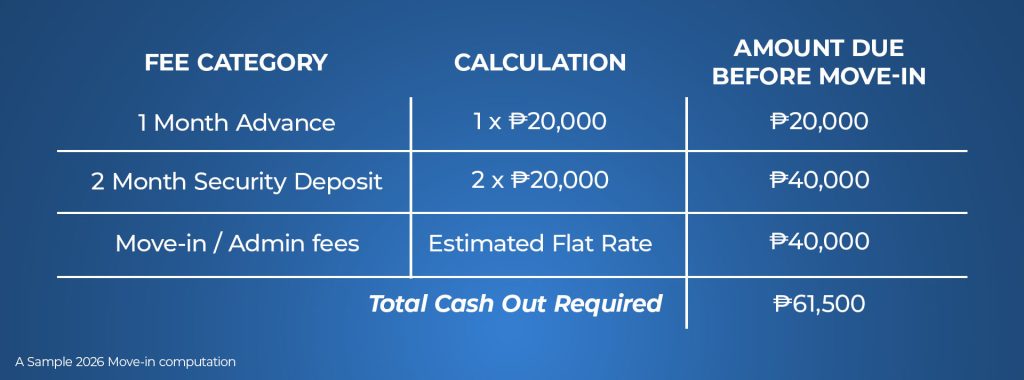
A Sample 2026 Move-In Computation
To visualize your actual cash out, let us assume you are renting a condo at ₱20,000 per month (inclusive of association dues).
Know Exactly What You’re Paying For
Before committing any lease, it is important to see the full financial breakdown—not just the advertised monthly rent. Hidden charges, such as unexpected utility deposits or fluctuating association dues, can easily derail your budget if they are not discussed upfront.
At Euro Towers, we provide clear, straightforward sample computations and will personally walk you through every detail of your contract, including:
- Total Move-In Cost: A precise computation of your advance rent and security deposits so you know exactly what is due on day one.
- Monthly Dues and Inclusions: A breakdown of your association dues, what building amenities they cover, and which utility bills you will need to manage independently.
- Lease Terms and Payment Structure: Clear guidelines on payment schedules, accepted payment methods, and any penalties for late turnover.
This ensures you can make a confident decision with full financial visibility—and absolutely no surprises.
Rent Direct, Rent Safe
Dealing with individual unit owners or third-party brokers can sometimes lead to confusion over who is holding your security deposit and who is responsible for paying the association dues on time.
The safest, most transparent way to rent in 2026 is to lease directly from the developer’s official property management team. At Euro Towers, we help reduce guesswork. When you rent a Ready-For-Occupancy (RFO) unit through our official leasing channels, you are provided with a crystal-clear, legally binding contract that outlines every single peso.
Vivaldi Residences Cubao: Enjoy the convenience of transit-oriented living right at the intersection of the MRT and LRT, with all association dues and rental terms clearly mapped out by our in-house team.
Milan Residenze Fairview: Secure a long-term, family-friendly lease near the MRT-7 without worrying about shady landlords withholding your security deposits illegally.
By understanding the financial mechanics of renting and choosing a reputable developer, you can ensure that your transition into your new home is seamless, legally protected, and entirely stress-free.
Do you want a personalized breakdown based on your budget? Message us and we’ll compute your estimated move-in cost.

References
C2M3 Properties. (2025, September 22). Condo monthly dues in the Philippines. https://c2m3i.com/news/article/association-dues-in-condo
Congress of the Philippines. (2009, July 14). Republic Act No. 9653: Rent Control Act of 2009. Official Gazette of the Republic of the Philippines. https://www.officialgazette.gov.ph/2009/07/14/republic-act-no-9653/
Mainline Power. (2026, January 12). Condo or house and lot in the Philippines. https://www.mainlinepowerph.com/blogs/articles/condo-or-house-and-lot-in-the-philippines
Respicio & Co. (2026, March 19). Rights of tenants regarding one month advance and security deposits. https://www.respicio.ph/commentaries/rights-of-tenants-regarding-one-month-advance-and-security-deposits